
How to choose a web design studio in Barcelona without buying blind

The hard part is not finding someone who builds websites in Barcelona. The hard part is knowing what you are buying before you sign.
So before comparing visual styles, compare how each provider works, who answers when something breaks, and what actually stays in your hands when the project ends.
This article will not tell you which studio to hire. The point is that you walk out of a first meeting knowing whether there is a method, whether the quote makes sense, and whether the relationship can hold for the length of the project.
The four types of provider you will find in Barcelona
There is no format that is best for everyone. The right provider depends on the scope, the budget, how much guidance you need and how involved you want to be.
1. Freelancer
A freelancer can be an excellent choice for a landing page, a small company website or a project with a very clear scope.
Advantages: direct contact, contained costs, speed, and the chance to work with someone highly specialised.
Drawbacks: capacity depends on one person. If the project needs several disciplines, some parts may be subcontracted or fall outside the offer.
Do not rule out a freelancer for being one person. Rule one out if the project demands more than they can cover and they cannot explain how they will handle that part.
2. Independent studio
A small studio usually works with a handful of people and a flatter structure than an agency. It fits when you want design and development coordinated without a large organisation around them.
Advantages: close contact with the people who actually design and build, fewer layers of communication, and continuity between the first meeting and the handover.
Drawbacks: less simultaneous capacity. If you need several workstreams at once, a small studio can fall short.
The important question is not how many people there are. It is whether the real team can cover your scope without improvising.
3. Agency
An agency can bring together strategy, design, development, SEO, content, advertising and account management.
Advantages: more capacity, deeper internal specialisation, and the ability to take on complex projects with many stakeholders.
Drawbacks: more structure can also mean more cost, and more distance between whoever sells the project and whoever delivers it. That is not always the case, but it is worth knowing from the start who your actual contact will be.
If you are choosing a web design agency in Barcelona, ask who will be involved at each stage and whether you will meet the team before signing.
4. Platform or low cost service
This covers heavily packaged services, subscription websites, marketplaces and offers where almost everything is predefined.
Advantages: a price that is easy to understand, a fast process, and enough for a business that only needs a basic presence.
Drawbacks: little flexibility, less distinctive design, technical limits, and possible recurring costs for features that would be part of the project in another model.
It can be a good fit if you want something simple. The problem appears when you expect a fully bespoke product afterwards.
Working in English in Barcelona
If your company operates in English, add one question to the list, and ask it early.
There is a difference between a provider who can deliver a website in English and one who will run the project in English. The first affects the pages. The second affects every briefing, every review round, every technical explanation and every message when something urgent breaks.
Ask which languages the day to day work will happen in, who you will be writing to, and whether the person answering technical questions is the person doing the work. A project stalls far more often on a misunderstanding than on a missing feature.
What to look at before the portfolio
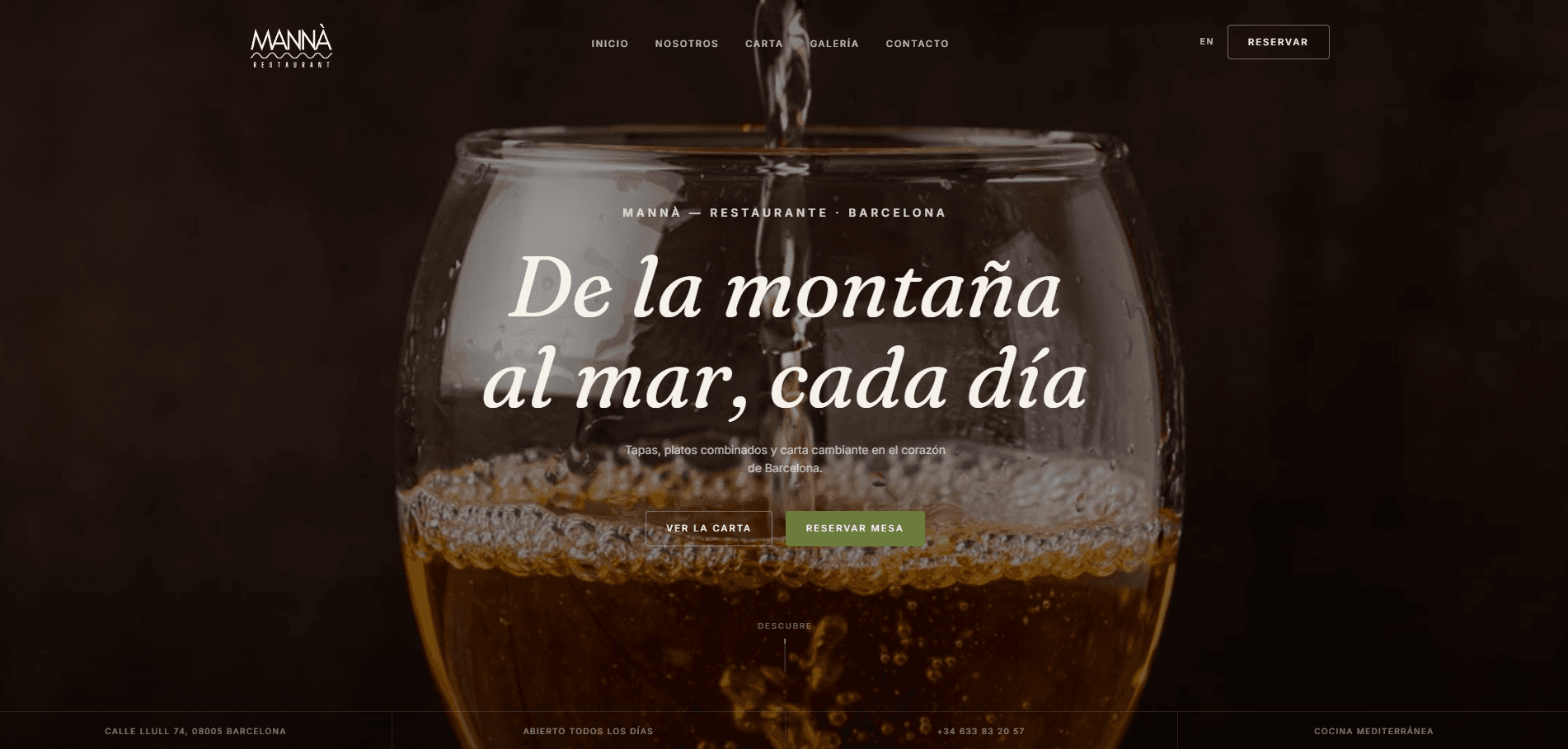
A portfolio tells you what some finished projects looked like. It does not tell you how anyone got there.
Before being won over by a nice animation, check four things.
The working method
Ask what happens between the first briefing and going live.
A solid answer should cover goals, structure, content, design, development, review rounds, testing and launch. The process does not need twenty phases, but it does need an order.
If it all starts with "send us your logo and pick a template", you already know what kind of service you are buying.
Who your contact will be
The person in the sales meeting is not always involved afterwards.
Ask who will answer during the project, who makes design decisions and who writes the code. It is also worth knowing whether you will speak to those people directly or whether everything goes through an account manager.
There is no correct answer. What matters is that the structure is transparent.
Ownership and access
Before paying, settle which accounts will be in your name and what you will receive at the end.
Domain, hosting, CMS, repository, analytics, Search Console, ad accounts, design files and licences should all be named in the proposal or the contract. Ownership of the code and of the assets created should never be assumed, because it depends on what was agreed and on the licences involved.
With WordPress, the software itself is distributed under GPLv2 or later, and WordPress explains how it treats derivative works within its ecosystem (WordPress.org).
On platforms such as Shopify, certain elements have their own licensing rules. Themes bought from the Shopify Theme Store, for instance, are licensed to the store that purchased them (Shopify Help Center).
What happens after launch
A website does not end on launch day.
Ask who handles incidents, updates, backups, small changes and future development. If there is a maintenance plan, it should be clear what it includes, what it excludes and how long a response normally takes.
Ask as well what happens if you want to change provider a year from now.
The 8 questions to ask in a first meeting
1. What do you need to know about our business before proposing a website?
A good answer sounds like this: questions about goals, customers, offer, sales journey, content, competitors, internal constraints, and what a visitor should actually do on the site.
If they start with colours before understanding what the site is for, the conversation is moving too fast.
2. What exactly is included in the quote?
Good answer: a concrete list of deliverables. Number of pages or templates, design, mobile adaptation, development, CMS, forms, integrations, basic technical SEO, analytics, migration, training, review rounds and support.
"A complete website" is not a scope.
3. What do you need from us, and by when?
Good answer: they tell you which texts, photos, access credentials, approvals or information they need, and what happens if those materials arrive late.
4. Who will actually work on the project?
Good answer: clear names or roles, responsibilities, and how communication will work.
5. How do you handle changes and review rounds?
Good answer: how many rounds are included, what counts as a correction and what counts as a change of scope.
6. What control will we have over the site once it is finished?
Good answer: access, accounts, files, the repository if there is one, documentation and licence terms.
If the answer is vague, ask for it in writing before signing.
7. How do you measure technical quality?
Good answer: mobile adaptation, accessibility, security, performance, indexing and real testing, not only hitting a particular score in a tool.
Google recommends assessing page experience as a whole, and states that good Core Web Vitals results do not guarantee top positions in search (Google Search Central).
Google also maintains specific documentation on Core Web Vitals and the metrics used to assess loading, responsiveness and visual stability (Google Search Central).
8. What would you not do on our project?
Good answer: the provider knows how to set limits. They may tell you a feature is not worth it, that a technology is unnecessary, or that an idea should be tested before it is built.
A provider who says yes to everything may be trying to close the sale rather than protect the project.
Concrete red flags
Some signals should make you ask for more information before accepting a proposal.
- They promise specific Google rankings without explaining what SEO depends on. Google is explicit that following its guidelines does not guarantee that a page will be crawled, indexed or served (Google Search Central).
- You cannot speak to anyone from the team who will do the work.
- The quote does not separate design, development, content, SEO, maintenance and licences.
- Nothing specifies what happens when you request changes.
- The domain or the main accounts are created solely in the provider's name with no clear reason.
- There is no approval step before everything is built.
- They do not ask about your goals, your customers or your content.
- The portfolio shows images, but they cannot explain what problem each project solved.
- The timeline looks too short for the scope, and they cannot say which parts are standardised.
- You are required to keep paying for maintenance in order to retain access to something you believed you had bought.
One signal on its own means little. What matters is whether the provider answers clearly.
Web design in Barcelona: indicative prices and timelines
There is no official rate for a web project in Barcelona. The price changes with the type of provider, the level of customisation, the number of pages, the content, the languages, the integrations and the features.
Drawing on published rates from Barcelona professionals and studios, freelancer marketplaces and Spanish pricing guides updated in 2026, these are reasonable ranges for professional projects. They are market references rather than official rates, and the amounts are quoted before VAT.
| Type of project | Indicative price | Indicative timeline |
|---|---|---|
| Custom landing page | 800 to 2,000 € | 1 to 3 weeks |
| Small company website, 4 to 8 pages | 1,200 to 4,000 € | 3 to 6 weeks |
| Advanced company website | 3,000 to 8,000 € | 5 to 10 weeks |
| E-commerce | 3,000 to 10,000 € | 6 to 12 weeks |
| Bespoke web development | from 8,000 € | from 8 to 12 weeks |
At the cheaper end there are packaged offers below these figures, while specialised studios and agencies can work with considerably larger budgets. Comparing the final price alone is of little use if the scope is not equivalent.
Do not compare two quotes on the total. Compare the scope.
A serious schedule should also state what depends on you: texts, photography, access and approvals.
Frequently asked questions
Is it better to hire a freelancer or a web agency in Barcelona?
It depends on the scope. A freelancer can be ideal for a small, well defined project. An agency makes more sense when you need several specialisms and simultaneous capacity. An independent studio sits in between, for projects where you want direct contact and more than one discipline.
What should a web design quote include?
It should describe deliverables, scope, review rounds, schedule, responsibilities, technology, licences, payment terms and support after launch. If something important was only discussed on a call, ask for it in writing.
How long does a professional website take?
There is no universal timeline. It depends on the number of pages, whether the design is bespoke, the integrations, and how quickly content is delivered and approved. To compare proposals, ask what the milestones are and what can block each phase.
What should I ask a web agency about SEO?
Ask which part of SEO is included: structure, indexing, metadata, performance, structured data, content, keyword research or tracking. Do not read "SEO included" as a promise of particular rankings.
How do I know I will be able to change provider later?
Ask in writing which access, files and accounts you will receive, which licences depend on the provider, and how a handover is carried out. If you work on an external platform, check that you hold administrative control of the main accounts.
Choosing well means understanding what you are buying
Before deciding, compare method, scope, contacts and exit terms, not only portfolios.
At Klent Creative we are two people working between Barcelona and La Rochelle, Kevin on design and development, Celeste on client relations and business development. We work in English, Spanish and French, we take on few projects at a time and we follow each one from start to finish. If your project needs a larger structure or a different model, choose the provider that fits that need best.
Sources
- Google Search Central, "Understanding page experience in Google Search results"
- Google Search Central, "Core Web Vitals and Google Search results"
- Google Search Central, "Google Search Essentials"
- WordPress.org, "GNU Public License"
- Shopify Help Center, "Understanding licensing and transferring themes on Shopify"